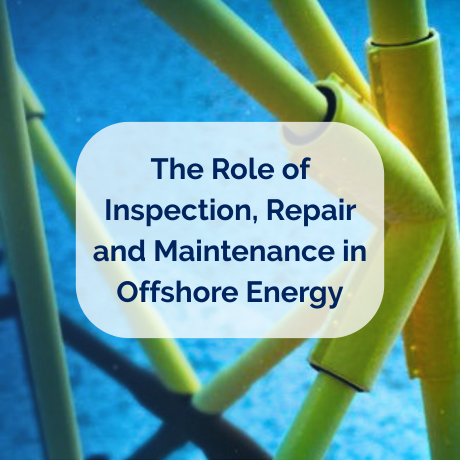
The Role of Inspection, Repair and Maintenance in Offshore Energy
Extending the Life of Critical Infrastructure
Energy installations at sea are built to withstand some of the most demanding operating environments in the world. Offshore assets such as platforms, pipelines and foundations must endure powerful waves, strong currents and corrosive seawater for decades. Over the life of an asset, however, conditions change. Structures age, environmental understanding evolves and components can suffer fatigue or damage. Inspection, Repair and Maintenance – widely referred to as IRM – plays a critical role in ensuring these assets remain safe and reliable throughout their operational life.
For operators, IRM is not simply about fixing problems when they arise. It forms an important part of managing structural stability and asset life extension.
The Challenge of Ageing Offshore Infrastructure
Many oil and gas installations currently in operation were installed decades ago. Since then, the industry’s understanding of environmental loading has developed considerably. Modern design codes – the engineering standards used to design offshore structures – incorporate far more detailed modelling of wave loading, fatigue cycles and other environmental forces. As a result, some existing structures may require strengthening in order to continue operating under updated standards.
In addition to changing design criteria, offshore assets can experience numerous structural issues over time. Corrosion, fabrication defects, accidental impacts, environmental damage and seabed movement can all affect structural integrity. IRM interventions allow operators to address these challenges in a controlled and targeted way, proactively ensuring their offshore assets are fit for safe and reliable operation.
From Inspection to Intervention
IRM activity typically begins with inspection campaigns conducted by the operators. Inspection personnel and/or ROVs (Remotely Operated Vehicles) or divers survey offshore equipment above and below the water line to identify any areas requiring attention.
These assessments can reveal issues such as:
- fatigue cracking (small cracks that develop in steel structures after repeated loading from waves and currents)
- pipeline freespans (sections of pipeline suspended above the seabed rather than resting on it)
- seabed scour (where currents remove sediment from around a structure’s base)
- localised damage to tubular members (the steel pipes that form the structural frame of offshore jackets)
Once a condition has been identified and the repair strategy established, specialist offshore contractors are engaged to carry out the necessary strengthening or remedial work.
This is where FoundOcean’s expertise in offshore grouting systems and installation techniques becomes particularly valuable. With sixty years of experience, we deliver grouted repair and reinforcement works for pipelines, jackets and other offshore components.
Jacket Strengthening
Filling jacket foundation legs or braces with grout significantly increases their rigidity. This enhances resistance to buckling and fatigue and, at the same time, allows the structure to meet updated loading requirements.
Grout infilling is also used where members have experienced local damage, such as bends, denting or partial buckling. This may have occurred during installation or, once in situ, through contact with a vessel. Grout infilling can be particularly useful for vulnerable areas, such as members that are adjacent to boat landings.
We carried out this technique on the Valhall Quarters Platform in the North Sea. Installed in 1979, the jacket required reinforcement to meet revised wave loading criteria. FoundOcean applied its grout infilling to the four legs of the jacket from sea level up to the cellar deck, increasing its structural capacity and supporting the rig’s continued operation.
Correcting Pipeline Freespans
During installation or through natural seabed scour, sections of pipeline may become unsupported by the seabed. Short freespans are not uncommon but, if they become too long, they introduce additional loading and vibration that will affect the long-term integrity of the line.
FoundOcean can install fabric formworks beneath the pipeline. Once lowered to the seabed on a skid and positioned by a diver or ROV, our technicians pump grout into the formwork to create a stable support. Depending on the height of the formwork, this may be done in stages to allow for curing times in order to achieve optimum stability.
We have applied this technique on projects worldwide, including the Zawtika development, a 300km long gas export pipeline in Southeast Asia, where the formworks we installed have created reliable pipeline support in challenging subsea conditions.
Grouted Repair Clamps
Grouted repair clamps provide another effective means of reinforcing pipelines and tubular members. There are two different types of clamp solution, unstressed and stressed – although that’s maybe a story for another day!
Installed around the affected area and with the annular space filled with grout, these clamps create a strengthened connection capable of transferring the structural load. The stressed grouted clamps exhibit high strength-to-length ratio and – combined with their ability to absorb significant tolerances – they are a very popular repair technique.
FoundOcean has completed numerous clamp installations, including repair work on the BP CATS gas pipeline in the North Sea, one of the UK’s major gas supply pipelines after it was damaged by a ship’s anchor and internationally, such as deepwater pipeline repair in the Gulf of Mexico, where we combined two solutions: a grouted repair clamp around the section of damaged pipeline along with a fabric formwork to support the additional load.
Stabilising Offshore Jacket Foundations
Seabed conditions also frequently influence the longevity of offshore foundations. Hydrodynamic forces can gradually remove sediment around jacket bases – the process known as scour.
When scour develops around mudmats (flat foundation plates at the base of jacket structures), sections of the foundation can lose contact with the seabed, potentially leading to movement and increased fatigue loading on some jacket types. To restore stability, grout-filled formworks can be installed beneath the affected mudmats. Once cured, additional grouting may be carried out within the leg-pile annulus to further secure the structure.
FoundOcean has carried out numerous jacket stabilisation projects in the North Sea and other offshore regions.
Supporting Long-Term Offshore Operations
Although IRM activities are often triggered by inspection findings, their broader objective is to prolong the operational life of valuable assets. Taking a proactive approach to IRM means operators can identify potential issues before they get ‘out of hand’ or threaten either to disrupt production or raise concerns about safety.
Strengthening members, stabilising foundations and repairing damaged components allow existing facilities to continue operating safely and efficiently.
Through our extensive range of subsea grouting solutions and offshore installation expertise, FoundOcean delivers repair and reinforcement works across both oil and gas and offshore wind developments.
As part of the Venterra Group, a group of ten member companies providing specialised services across the lifecycle of a wind farm project, FoundOcean also operates within a much broader network of engineering and offshore service providers supporting the offshore wind sector.
When it comes to the Strengthening, Modification and Repair side of IRM, we can immediately call upon the expertise and practical application of our partner, GDG Engineering (Gavin & Doherty Geosolutions) to find the best solution for any kind of remedial action.
Maintaining the Foundations of Offshore Energy
Offshore energy assets represent major long-term investments. Ensuring their safe and reliable operation across their intended lifespan remains essential to sustaining energy production at sea.
IRM plays a key role in achieving this, allowing operators to adapt or improve their legacy installations so that they can continue production in evolving conditions while continuing to meet modern standards.
Through decades of experience delivering offshore grouting repairs and strengthening works, above and below the water, FoundOcean continues to support the long-term integrity of offshore energy assets worldwide.
For more information on FoundOcean’s IRM capabilities, contact the team on +44 1506 440330 or email info@foundocean.com.