Cable Protection System Repair Case Study
The Impact of Scour
Erosion can have a huge impact on subsea infrastructure. One especially common cause is scour. The seabed is constantly changing and being reshaped by currents, tides and storms which move sand and sediment from one place to another. This can lead to erosion occurring at the base of a structure or around a cable, causing stress points which make it less protected and more susceptible to damage.
In the North Sea, the site of a great number of the world’s offshore wind farms, much of the surface of the seabed is sandy, which means it can easily be stirred up and displaced. As a result, protective measures need to be in place, and the places where cables rise up from the seabed to the structure – known as free span – are encased in a Cable Protection System (CPS). This ‘extra layer’ of casing protects the free span cables against abrasion or impact at their most exposed points.
Repairing Damage to a Cable Protection System
FoundOcean was called in by the operators of an (unnamed) offshore windfarm in German waters where there had been more scour than expected. This was beginning to cause damage, especially around the foundations of the offshore substation (OSS).
As part of routine maintenance, the site would have annual inspections using ROVs to scan the area and capture images of any erosion. One such inspection revealed that – on the free span part of the structure – more sand had washed away than in previous years or as initially predicted in the pre-construction site surveys. This meant that some cables were now not protected as well as needed.
The OSS is the heart of the wind farm, connecting all the cables bringing energy from the turbine strings into the substation and feeding it onshore to the energy companies and the grid. The cables needed to be stabilised as a matter of urgency to prevent any further disrepair, so that the windfarm could continue to deliver power.
The operators acted extremely quickly and asked FoundOcean to bring their expertise to this problem. They also wanted to discuss a solution that could be plastic-free … more on that in a moment!
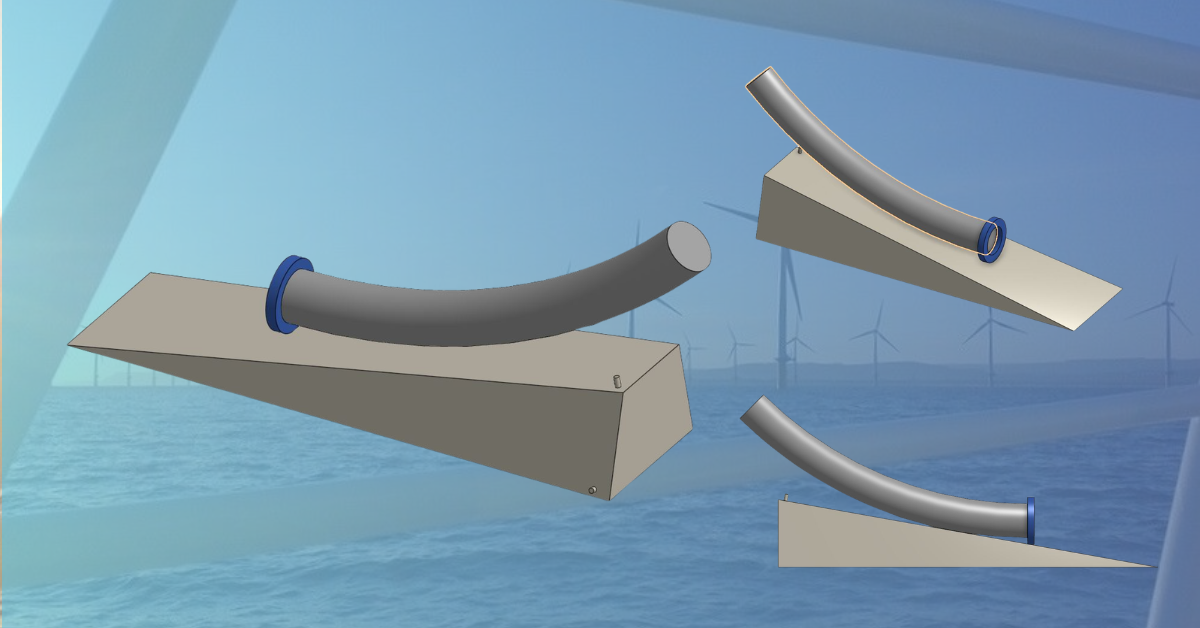
We started working on the two most damaged cables, to stabilise them on the seabed and allow for the damaged Cable Protection System to be repaired. We installed 2 wedge-shaped fabric formworks.
These formworks:
- supported the J-tube cables
- evened out the dip in the seabed caused by scour
- allowed more CPS to be added
To carry out this work, the wind turbines were switched off and earthed. Then the cables were raised and our fabric formworks were lowered into position; our standard strength grout was pumped through hoses into the formworks, then the cables were lowered back into place.
Even during the process, we could respond quickly to a developing situation. As the team filled the formworks, they observed that a cable would start sinking into the seabed because of the heaviness of the grout. They were adaptable and discussed the required adjustments, recalculated, and continued the work, correcting the issue and supporting this repair project safely and efficiently.
With the scour damage on the two most-impacted cables now addressed, the project carried on to ensure that all the cables on the windfarm were stabilised and any lesser signs of CPS damage repaired.
Plastic-free Biodegradable Formwork Bags
This project was particularly significant for FoundOcean, as it was the first time we had installed our biodegradable formwork bags.
Standard formwork bags are composed of a woven polypropylene blend for flexibility, permeability and durability. After testing various materials for robustness, we developed a greener alternative: fabric formworks made from natural hessian fibres.
Developing formworks that do not risk microplastics getting into the water is important for protecting underwater ecosystems and is continuing to be a hot topic internationally. In 2022, at the UNEA (United Nations Environment Assembly), the Roundtable on Marine Litter highlighted the importance of “reducing the open use of plastics in the marine/coastal environment (e.g. geotextiles, corrosion protection of offshore installations).”
Legislation in Germany then echoed this sentiment. In August of the same year, Germany joined the international High Ambition Coalition to End Plastic Pollution by 2040. The rulings applied to all windfarms in German waters, stating that companies must minimise plastic use on subsea and marine infrastructure that could be liable to degradation and lead to microplastics in the water.
According to the Federal Ministry for the Environment, Nature Conservation, Nuclear Safety and Consumer Protection, the plastic volumes found in rivers and lakes are expected to more than triple between 2019 and 2060. In the same period, the volumes in oceans could increase fivefold, from 30 million tonnes to 145 million tonnes. Studies have repeatedly shown that microplastics are entering the food chain, having been detected in fish, shellfish and other marine organisms across a wide range of environments. For this reason, it is incredibly important to address microplastics in our waters, and to find and utilise greener solutions.
FoundOcean continues to offer all customers – not just those with structures in German waters – the opportunity to install natural-fibre, biodegradable fabric formworks in their projects. As well as the clear environmental benefits to the planet and all who live on it, this will also support businesses in their Environment, Sustainability and Governance (ESG) targets.
For more information on FoundOcean’s experience and capabilities, contact the team on +44 1506 440330 or email info@foundocean.com